You can also add the show’s RSS feed to your podcast app to follow us directly.
Robinson Meyer:
Hello, it’s Wednesday, September 9, in the unofficial first week of fall here in the United States. I was out on vacation last week at a great time. And so this week, we’re going to bring you a classic episode of Shift Key. It’s actually one of my favorites that we’ve ever done on the show. I still think back to it all the time. It began our Shift Key Summer School series in 2025. In less than an hour, my old co-host Jesse Jenkins and I are going to try to walk through some of the biggest concepts in energy and electricity and the power grid and explain what gives rise to them and how they work. So this episode is like a one-hour tutorial on how to think about energy, power, watts, horsepower, volts, amps, and what uses approximately one watt-hour, one kilowatt-hour, one megawatt-hour, and one gigawatt-hour. These are terms we use all the time, but don’t always necessarily explain or, fully decode. And so if you care about climate and energy, but have never listened to this show or need a refresh, I encourage you to stick around. We’ll be back next week with a new episode of Shift Key. In fact, more than one new episode, I think. Until then, I’m Robinson Meyer, the founding executive editor of Heatmap News, and you are listening to Shift Key.
Jesse, let’s start.
Jesse Jenkins:
Yeah, let’s start at the big question. I mean, energy is a weird thing, right? Because it comes in so many different forms that it takes on all kinds of different units, as we’ll talk about here later. And it can kind of be dizzying as we convert back and forth between different forms. And also, we only really experience it like in a physical sense in a couple of its forms, unless you’re shocking yourself. You’re not really feeling electricity on a regular basis, right? And so I like to think of energy to start with in kind of its basic, define its basic terms, right? It’s supposed to be basic scientific information units, SI terms, and then to get a physical intuition for those units. So let’s start with the Joule, all right? The Joule is the SI unit for both work and energy. And the basic definition of energy is the ability to do work, not work in a job, but like work in the physics sense, meaning we are moving or displacing an object around. So a joule is defined as one Newton meter, among other things. It has an electrical equivalent to a Newton is unit of force. And so force is accelerating a mass, right, from basic physics over some distance in this case. So one meter of distance. So we can break that down further, right? And we can describe the Newton as one kilogram accelerated at one meter per second squared. And then the work part is over a distance of one meter.
Jesse Jenkins:
So that kind of gives us a sense, something you feel like a kilogram, right? That’s 2.2 pounds. I don’t know. I’m trying to think of something in my life that weighs a kilogram. I don’t know, a couple pounds of food, I guess. A liter of water weighs a kilogram by definition as well. So if you’ve got like a liter bottle of soda, there’s your kilogram. And then I want to move it over a meter. So I have a distance, I’m displacing it. And then the question is, how fast do I want to do that? How quickly do I want to accelerate that movement? And that’s the acceleration part. And so from there, you kind of get a physical sense of this. Something requires more energy if I’m moving more mass around, or if I’m moving that mass over a longer distance, right? One meter versus a hundred meters versus a kilometer, right? Or if I want to accelerate that mass faster over that distance, right? So zero to 60 in three seconds versus zero to 60 in 10 seconds in your car. That’s going to take more energy to accelerate that that rapidly.
Robinson Meyer:
I’m looking up, What weighs? Oh, here we go. A Mac, a 13-inch MacBook Air weighs about a little more than a kilogram.
Jesse Jenkins:
So, so your laptop. Yeah. If you want to throw your laptop over a meter, accelerating at a pace of one meter per second squared. That’s about a joule. That’s, that’s about a joule.
Robinson Meyer:
It’s not a ton.
Jesse Jenkins:
It’s not a huge unit of energy. We obviously like you’re moving your body around, right? It weighs a bit more than a kilogram, at least mine does. And you’re moving around, accelerating all over the place, walking around like that is using up energy on a regular basis. So joules are pretty small. And that’s important because a joule, a watt, which is actually a unit of power, not a unit of energy, is described as a joule per second. So if energy is a quantity, it’s something that we’re consuming or producing or transporting or converting, then power is the rate at which we’re doing that. So if I’m consuming a joule of energy in a second, that rate of consumption is one watt. One analogy for that is like a bathtub, right? Like the amount of water in the tub, the volume of water, that’s the energy. And the size of the faucet or the rate at which the faucet is adding water to your tub, that’s power.
Robinson Meyer:
I’m raising my hand.
Jesse Jenkins:
Does that make any sense? Yeah, okay. Robinson has a question. Yes, Robinson.
Robinson Meyer:
Okay, so I have a few questions. The first is I just want to, I think it is kind of important to establish like energy here, the joule, what that changes about a substance. And I realize this is like high school physics, physics 101, is the acceleration, not the velocity. Like we sometimes think of energy as a property of velocity, but it’s actually the ability to change velocity. That is what energy does.
Jesse Jenkins:
Right. Yeah, that’s right. I think about the kind of basic Newtonian mechanics. Right. If you’re if you’re in a, you have an object in a vacuum with no friction, right, or no forces working against it, it will continue at the same velocity and the same trajectory forever. Right. And so the what it requires energy is to change that direction or velocity, which requires acceleration or the application of force to some mass.
Robinson Meyer:
You just kind of said this, but like, what is the difference between energy and power?
Jesse Jenkins:
Yeah. So energy is the actual thing that it’s the quantity of the thing that’s doing work, right? So it’s the amount of fuel we burned or the number of calories we had to eat to run our bodies over the course of a day or the amount of electricity we had to generate to run our lights or our computer. Power is the rate at which that energy is consumed or supplied or transported or transformed. And so it is not itself a unit of quantity. You don’t use power. You use energy. Power is the rate at which you’re using energy. So again, it’s how quickly the bathtub is filling up or draining, not the quantity of water in the bathtub. So a watt is the basic unit for the SI unit for power, which is going to be equal to energy divided by time, energy over some period of time. So power, energy, and time are fundamentally related in that way. Energy is equal to power times time. So when we talk about electricity units of energy, we usually use the term watt-hours instead of joules. That’s a watt of power sustained over an hour. That’s the quantity of energy that would be delivered over an hour if we were sustaining it at a rate of one watt. So energy equals power times time, power equals energy divided by time. And then I guess time is energy divided by power, if you want to think about it that way.
Robinson Meyer:
So a watt is not specific to electricity. A watt we could actually talk about for any kind of energy. It’s just the fact that we could even describe your car motor.
Jesse Jenkins:
Yeah. And in fact, in Europe, they do that. They don’t use horsepower. That’s another unit of power. It’s kind of a weird one when you think about it, right? Like, what is a horsepower? Or in the U.S. and in the UK,
Robinson Meyer:
It’s one horse’s power. So yeah, exactly.
Jesse Jenkins:
There’s no confusion about this to me. How big a horse? I have questions about this horse. And in Europe, you’ll often actually see the motors, the engine power rated in kilowatts, which is your maximum power output from that motor. Obviously, when we switch to electric motors, that makes a lot more sense too, because now we’re even talking about electrical power. And when we talk about power plants having a number of watts or kilowatts or megawatts or gigawatts, that’s usually the maximum power output that plant can deliver, right? So it’s a rated power or maximum power. And it doesn’t necessarily produce at that maximum power all the time, right? Think about a wind farm that’s varying in its output with the wind or solar, the sun, or even a nuclear plant that has to shut down for maintenance. And so if you want to understand how much energy a power plant produces, you have to know the power at which it’s producing integrated over time, or what we call the capacity factor, which is the average power of that plant over a given amount of time.
Robinson Meyer:
I want to go there in a second. But first, I want to make sure I understand something correctly, which is as an energy reporter, or as a person who reads energy documents and reads energy stories, reads heat map, there’s a discussion been both of kilowatts, but really of kilowatt-hours. And am I right to understand that one watt, if one watt times one second equals one joule, right? That’s correct, right? Yes, that’s correct. A kilowatt-hour is a, even though it sounds like a chunky unit, and sometimes I feel like it’s a bit of a weird unit to throw around, it is the same, it’s measuring the same kind of thing that joules are measuring. In other words, when I throw my laptop one meter, and from that distance at one meter for a second, right? Right. That’s actually, the thing we’re measuring by saying that I’ve just expended one joule of energy is the same ultimate substance that we’re measuring when we say a solar farm put out 60 kilowatt-hour.
Jesse Jenkins:
Yeah, that’s right. And that’s worth pausing on because, again, this is why energy is so slippery a concept, because it can come in so many different forms. And we often use different units when we’re talking about a different form. So when it’s electricity, we often, we talk about kilowatt-hours or megawatt-hours. We should pause and say a kilowatt is a thousand watts, right? So a kilowatt-hour is a thousand watt-hours.
Jesse Jenkins:
So we got all these prefixes too. But, you know, you could, so we’ve talked about defining energy in physical terms, right? Displacing a kilowatt over a meter at some, at a meter per second squared of acceleration. But you can also think about it in heat terms. So, you know, heating up a body of water or heating up a room, right? That’s going to require energy to do that, right? Energy coming out of your furnace or your fireplace or whatever else. And we often have different units for that too. So calories are the standard unit in SI terms. Whereas we also often talk about British thermal units or BTUs in energy world. This is an imperial unit that we rarely use outside of the U.S.. Those units are defined in terms of the amount of heat required to usually to heat up some unit of water. So, for example, a calorie is defined as the amount of heat required to raise the temperature of a liter of water by one degree Celsius. And that’s the kilocalorie. That’s the big calorie. The small calories or gram calories is one millimeter of water raised by one centimeter. So that’s the other way we can think about it as like a heat flux, right? That’s what a lot of our energy goes to combustion, right? To generate heat and then do something with that heat.
Jesse Jenkins:
So that’s another way to get a physical intuition for energy. But then often we use different terms. Energy, of course, can also be contained in the chemical bonds of certain things. That’s what we’re combusting. We’re breaking up the chemical bonds of wood or coal or natural gas. And so then we also talk about the heat content of or energy content of those fuels. And you can use joules for that. You can use BTUs. You can use calories. You could use megawatt-hours or kilowatt-hours. Or in many cases, they use physical units to describe different types of fuels as well. So you might hear things like barrels of oil or millions of tons of coal. Those all have to be standardized units of energy as well which just adds to the confusion
Robinson Meyer:
So one calorie one kilocalorie i believe is 4 186 joules.
Jesse Jenkins:
Yeah of course you can do that mental math in your head right
Robinson Meyer:
I do it all the time so i think what’s interesting here is that you know the hue if you think about a standard this isn’t quite standard anymore but if you think about of people eating 2,000 calories a day, that means the human body’s expending like 8.3 million joules a day.
Jesse Jenkins:
Yeah, 8.3 megajoules.
Robinson Meyer:
I think, yeah, exactly. That’s 2.3 kilowatt-hours. So does that mean actually people use more? How many, what’s a household use of kilowatt-hour? Like one point something?
Jesse Jenkins:
No. So a typical household in the U.S., and this would be less if you’re in Europe or somewhere else, consumes a little bit over a kilowatt of average power. So that’s the average rate at which they’re consuming electricity. Now, of course, it goes up and down as you turn off on and off devices, right?
Robinson Meyer:
That’s about 24 kilowatt-hours a day.
Jesse Jenkins:
Right? Exactly. So that’s a little over 24 kilowatt-hours a day.
Robinson Meyer:
So a family of three.
Jesse Jenkins:
Yeah. So according to the U.S. Energy Information Administration, the average U.S. household consumes about 10,500 kilowatt-hours of electricity a year. So that’s about 28, 29 kilowatt-hours a day or about 1.2 kilowatts average over the course of the day.
Robinson Meyer:
Well, I’m now just thinking about, you know, the average diet for a person, right? It’s 2,500 kilocalories, which is about 2.5 kilowatt-hours. So what?
Jesse Jenkins:
Yeah, that’s a good, that’s a good way to think about.
Robinson Meyer:
Your house is using 10 times as much energy as your body is at any, through the day.
Jesse Jenkins:
And that’s just the electricity. Yeah, that’s just the electricity part of the energy too. If you’re driving to work in a car that’s not electric, you’re not, that’s not counted in that energy consumption that you’re in and you’re consuming the energy in your gasoline. If you’re heating your home with natural gas, right, that’s not counted there too. But yeah, to give a sense of scale, I like that. One human is 2.4 kilowatt-hours or something like that. Four kilowatt-hours is the amount of energy you’d need to run a window AC unit of a half a watt, half a kilowatt for eight hours. You want to cool yourself for eight hours a night while you’re sleeping, that is four kilowatt-hours. So usually we’re thinking about most things we’re doing that are like major energy users are in the kilowatt-hour scale.
Robinson Meyer:
I like this because I think, I mean, there’s a certain element to where this is getting a little matrixy, where we talk about humans producing kilowatt-hours of electricity. But no, I like this because it makes sense, right? I have one more question, which is in energy writing and energy reporting, I think there’s often... It’s very common, simply frankly, in writing to avoid echoes, to avoid repetition, to vary referring to energy as power or referring to it as energy. Do you think that’s okay? Do you think that’s forgivable? Or are there moments where we’re writing about power that we should be sure to call it power and moments where we’re writing about energy? Because I think especially writing about the power grid, referring to electricity, energy and power, those things are basically treated as interchangeable, even though from a physics perspective, they aren’t.
Jesse Jenkins:
So as we’ve talked about here, the way we experience the grid is in terms of energy, right? It’s in terms of the amount of energy we’re using to do something useful. So I would recommend generally reporting it in those terms, in energy terms. And that’s just because the rate at which we consume energy or the power varies dramatically, as we were talking about over the course of a day. Do I have my EV charger on or off? Do I have my air conditioner on or off? These cause huge swings in the rate at which we’re actually consuming that energy or the power rate. And that’s also true on the generator side, too. Think about particularly we’re talking about reporting the size of an offshore wind farm or a solar plant. You usually will hear that expressed in terms of its maximum rated power output. It’s a 300 megawatt wind farm, for example. That’s the maximum it can produce or the maximum power rate at which it can produce. But it doesn’t sustain at that rate all the time. And so the average power rate is much lower than that. And that’s where this capacity factor concept comes in, which is basically the average power rate divided by the maximum possible. So if we say a wind farm has a capacity factor of 50%, then that 300 megawatt wind farm, that’s 300 megawatts of maximum power, is varying around between zero and 300. On an average, it’s producing energy at a rate of 150 megawatts.
Jesse Jenkins:
Even a nuclear plant isn’t running constantly. That’s as close as you get to an equivalence between a power rating and an energy output because it runs 90% of the time. But even there, the nuclear plant turns off for 12 weeks every 18 months to refuel. And so it’s not producing all the time either. So I would probably counsel describing things in energy terms for the most part, because that’s what we actually experience as heat or as acceleration of mass or other things that we can feel in our daily lives.
Robinson Meyer:
Let’s talk about scale for a second. So in writing about electricity and in writing about renewables specifically, you encounter these kind of like big units, right? You encounter watts, but you really encounter kilowatts, megawatts, gigawatts, and then at the scale of national systems, terawatts. And for ease of use, these energy units are almost always followed up by, and this is the number of households it powers, right? This is the number of average households it’s going to power. But the thing is, when you start digging under the surface, there’s a huge amount of variance in those household terms. And I think it really obfuscates how people understand the energy system and the power grid. So how much are these units, if we want to switch to a unit first and a watt first way of thinking about renewables and thinking about electricity, How big is a kilowatt? How big is a megawatt? What is the right comparisons to hold in our head for those that don’t require just converting to like, oh, this is 10,000 households and this is a million households?
Jesse Jenkins:
Yeah. So again, if you’re thinking in watts, you’re talking about power. And so there, again, it’s like, are you trying to describe an instantaneous power, a maximum power, an average power? Those are all different things. I think the key thing is, if you’re talking about power, you got to start with what am I actually trying to describe? And if I’m not actually trying to describe a unit of power, I’m actually trying to describe a unit of energy, which is like how much energy households use, then we probably shouldn’t be using watts, or we should be using watt-hours or their equivalent. So that’s my first point. So let’s talk about scale.
Robinson Meyer:
Yeah.
Jesse Jenkins:
So to follow my own advice, let’s start with the energy units first, and you’ll get the relationship here between energy and power to some degree in this explanation. So if I’m talking about the amount of energy that a computer, a laptop or a light uses over an hour, for example, that’s the scale of like tens of watt-hours. So a 10 or 15 watt LED bulb, that’s the maximum power it’s consuming when it’s on. So if you have a 10 watt bulb on for an hour, that’s 10 watt-hours. The draw of a typical laptop, if you look on the back, it’s, let me see what mine is.
Jesse Jenkins:
It looks like my laptop is rated at 60, 60-ish watts of power draw. So if it’s on and I’m computing at its maximum power draw for an hour, then I’m using 60 watt-hours. Personal electronics, lights, those are on the scale of watt-hours per hour. You know, so I’m, you know, if I’m using it for days or weeks, then it might grow to a kilowatt-hour. But if I’m thinking about kind of the near term use of a period of hours of a laptop, cell phone, or an LED light, those are in the scale of watt-hours. If we’re talking about other larger consumers of electricity, or again, the scale of annual of daily use of a human, then we’re at the scale of kilowatt-hours or 1000 watt-hours. So like you said, a human uses roughly 2.5 kilowatt-hours of food a day. If you’re running your air conditioning unit over the course of the day, that’s going to be in singles to tens of kilowatt-hours. Your solar panels on your roof are usually on the scale of 5 to 10 kilowatts of maximum capacity. And so they produce 25% on average. Maybe they’re producing four kilowatt-hours per hour on average and seven kilowatt-hours per hour and the sun is up. Something like that and your chargers as well your ev charger is also on the scale of several kilowatts also
Robinson Meyer:
This episode of Shift Key is sponsored by RE Plus 26, the largest and most comprehensive clean energy event in North America, bringing together 37,000 clean energy professionals and more than 1,100 exhibitors from November 16th through 19th at the Las Vegas Convention Center. Experience a complete agenda spanning solar, storage, microgrids, EVs, grid-edge technologies, and beyond, with tracks built around policy drivers, tech trends, land use, grid integration, finance, and business strategy. At REplus26, you can network with the companies and experts advancing projects, improving supply chains, developing resilient solutions, and more, plus the tools to find them. Whether you’re sourcing new technology scouting your next partner or just trying to keep up with where this industry is moving you’ll find it here all in one place all in one week it’s re plus 26 this is where today’s energy is being built to meet tomorrow’s demand register at replus.com and use code shift key 20 that’s shift key 20 to save 20 off a full conference pass.
Robinson Meyer:
One reason load growth has come back, right, is because through the 20 teens, and at least this is my understanding, you should correct me if this is wrong, but through the 20 teens, we were basically increasing the efficiency of the power grid at the same time that we were adding new demand to the power grid. And we were increasing the efficiency because we were replacing the stock of incandescent light bulbs with LED light bulbs. Basically, like that was the biggest story in electricity demand. And if just to go back to your units, like if you think about how much power an incandescent light bulb draws, it’s like 60 watts. And now, as you were saying, it’s 60 to 100. And now, as you were saying, LED light bulb draws like 10. Like that’s where the demand growth went during the 20 teens. And the fact that we’ve now basically finished converting, you know, most light bulbs in the United States to LEDs and but are still adding new capacity, like no wonder demand growth is back. Anyway, I just wanted to interject that because I was really, I think it’s evocative of how, like, we’re talking about 50 watts per light bulb, which is a lot, but also how these small, relatively small differences in power units add up to, massive utility scale decision making. Anyway, though, as you were saying, EV, it drives a kilowatt.
Jesse Jenkins:
Yeah, EVs are on the scale of kilowatts. Yeah, no, that’s helpful, I think, to remember. And it’s interesting because, of course, electricity was first used for lighting. That was its first application way back when. And now it’s interesting that lighting has become so efficient that it’s such a tiny sliver of the overall electricity usage nationally now. And so many other things, air conditioning and increasingly EVs and heat pumps and data centers and computing and everything else are the big drivers. So, yeah, a couple other things that maybe are to give us, again, on like a household scale that we’re used to interacting with. I mean, one would be a tank of gasoline in your car, right, in your conventional car. So a gallon of gasoline contains about 40 and a half kilowatt-hours, 40.5 kilowatt-hours. So one gallon of gasoline is on that scale of a couple gallons of gasoline, I guess, are on that scale of like average household electricity use over the course of a day. Now, of course, you can’t turn gasoline directly into electricity at a one for one conversion ratio, right? You got to use a diesel generator, which itself is only maybe 30% efficient. So it actually takes a lot more than that. And that’s also partly why electric motors are so much more efficient, right? At taking the energy in your battery and converting them into traction in your cars, because there’s already electricity. You don’t have to combust anything to make heat and then drive motion and then turn that motion into power in your wheels, right?
Robinson Meyer:
There’s a lot less heat loss. Yeah.
Jesse Jenkins:
Yeah. Tons less. Yeah, exactly. So internal combustion cars, maybe a third as efficient as an electric vehicle. So yeah, tank of gas, 10-gallon tank of gas, 400-ish kilowatt-hours. That’s actually quite a lot. This is why fossil fuels are so amazing. You can fill 10 gallons of gasoline and have an enormous amount of energy from a kind of personal perspective.
Robinson Meyer:
Right. I mean, it is actually like when you fill up your car’s gas tank, let’s say it’s eight to 12 gallons, relatively.
Jesse Jenkins:
It’s a lot. Several hundred kilowatt-hours.
Robinson Meyer:
That’s your weekly or even more than weeks worth of household electricity use.
Jesse Jenkins:
Right. And also I should think about it’s about a week’s worth of commuting, too. Right. You don’t use up your full gas tank in a day, usually, unless you’re an Uber driver, perhaps. Yeah. So then anyway, so now we’re, yeah, we’re in like weekly scale consumption. Now we’re talking about megawatt-hours, whether that’s your commute energy usage or your household energy electricity usage. Then when we talk about gigawatt-hours, now we’re starting to talk about power plant scale, right? Or data center scale or industrial facility scale. A large nuclear reactor is typically on the scale of about a gigawatt or a billion watts. It’s a million kilowatt-hours or kilowatts. So a gigawatt scale power plant, again, producing for an hour would produce one gigawatt-hour of electricity. So when we’re in that scale of gigawatt-hours, we’re talking about the output, sort of the hour by hour output of a large power plant, or a large data center or something of that scale. Those are going to be in your gigawatt-hour terms. And then you indicated earlier terawatts, that’s the next scale up, 3,000 gigawatt-hours is a terawatt-hour. Now we’re talking about the scale of annual production for a power plant or annual consumption for a state or a data center or something like that. Those are going to be in the scale of hundreds of terawatt-hours. And nationally, we consume about 4,200 terawatt-hours of electricity annually in the U.S. today. So there’s now we’re in the 1000 terawatt-hour scale. Now we’re talking about national annual electricity usage.
Robinson Meyer:
I think you skipped directly from megawatts to from kilowatts to megawatts. But can you briefly talk about megawatts?
Jesse Jenkins:
Yeah, megawatt is 1000 kilowatts. So a megawatt-hour is 1000 kilowatt-hours as well. And then that’s, again, the scale of your weekly electricity consumption in your home or your weekly consumption of gasoline for your commute, or maybe several weeks.
Robinson Meyer:
Renewables. I mean, I feel like when we talk about solar farms, we’re usually talking about in the world of megawatts.
Jesse Jenkins:
So that’s true. Most power plants are smaller than a gigawatt. A nuclear plant is big. Most power plants are several tens to hundreds of megawatts scale production. So if they’re producing for an hour, then you’re in the tens to hundreds of megawatt-hours range. But if they’re producing for a year, you’re more like terawatt-hours.
Robinson Meyer:
I just want to stick in megawatts for a second, because it’s actually when we talk about renewables and when we talk about renewable sized additions to the power grid, we tend to be in megawatts. Only when you talk about these giant generating sites, like Vogel units three and four are each, I believe, more than a gigawatt. They’re like 1.2 gigawatts or something. You talk about these massive, massive new nuclear power plants, then we’re talking about gigawatts. But mostly in the world of when we talk about adding new power demand, especially from renewables, it tends to be in megawatt-hour world. Just for instance, A technology that we don’t hear very much about anymore, concentrated solar thermal, but that if you’ve ever flown across the country, I’m just thinking about this because I think it’s evocative. When you fly across the country, there are two big concentrated solar plants. These are the mirrors that point at the single tower and then boil things. And when birds fly across, they instantly get incinerated. but anyway um uh, evampa this famous concentrated solar thermal plant that went up early in the obama administration and is going to close actually next year that is 392 megawatts.
Jesse Jenkins:
Yeah you would see this out your window if you’re flying from
Robinson Meyer:
Exactly that’s why los.
Jesse Jenkins:
Angeles over towards las vegas
Robinson Meyer:
And exactly we’ve had folks from furvo energy the advanced geothermal company on this podcast. They’re working on applying, as we’ve discussed then, Firvo is the company, one of the several companies that’s working on applying fracking techniques to generating clean electricity through drilling new geothermal wells. Cape Station in Beaver County, Utah, their big demonstration project, that’s 400 megawatts.
Jesse Jenkins:
When it’s fully built out.
Robinson Meyer:
That’s going to be 400 megawatts when it’s fully built out. Empire Wind, which is the big Equinor offshore wind project in New York State, is 810 megawatts. And so just to give you a sense, what is the average combined cycle gas?
Jesse Jenkins:
A couple hundred megawatts.
Robinson Meyer:
A couple hundred megawatts. So just to be clear, when we talk about power plants, normally we’re in this world of talking about megawatts. anyway though.
Jesse Jenkins:
Yeah, or hundreds of megawatts.
Robinson Meyer:
Or hundreds of megawatts.
Jesse Jenkins:
Or another perspective is Princeton University has a gas turbine here that we use to generate some electricity as well as use the waste heat for heating and cooling of the campus. We’re going to shut that down soon and replace it with our ground source geothermal project. But that’s a 15 megawatt turbine. So for the scale of a single campus, you might have a tens of megawatt scale facility. The data centers, like the big exascale data centers we’re talking about, like giant ones, Those are usually in the hundreds of megawatts to even gigawatt scale facilities now that we’re talking about some building out three, four or five gigawatt scale campuses for data centers. So that’s pretty wild. The other way to think about a gigawatt, I usually think of it in terms of if, again, if it’s a gigawatt of average consumption, that’s like 800,000 homes. So if you assume two people per home on average, that’s like a city of one and a half million people scale. So a gigawatt is a city scale of consumption or production on average, which starts to give you the sale of these data centers, right? If it’s a gigawatt scale data center, we’re talking about like plopping down another one and a half million people’s worth of electricity use with one of those facilities. That’s big.
Robinson Meyer:
How do you convert? You just kind of did it off the cuff. But often when you see these megawatt, gigawatt numbers, they’re immediately followed by a conversion to homes.
Robinson Meyer:
And I think when you’ve been paying any attention to this, you realize that these conversions could be like, are especially in PR documents are like so off the cuff. They’re like not comparable at all. What do you think is the best?
Jesse Jenkins:
There’s some embedded assumptions in there.
Robinson Meyer:
Yes, exactly. And they also vary a lot by region, where like Texas homes use a lot more electricity than homes in the Northeast.
Jesse Jenkins:
Yeah, so there’s a couple of kind of embedded assumptions there. The most important of which is the average power output of the facility versus its maximum. And then what you assume for how much electricity a household uses. So let’s take the Empire Wind Project. You said it was 810 megawatts. That’s its maximum capacity.
Jesse Jenkins:
Let’s assume it’s about a 50% capacity factor. That’s a good average power output ratio for a wind farm. So, you know, wind farms in the Great Plains states on shore, they might be approaching 50% capacity factor. Offshore wind, maybe they’re in that range, 40 to 50%. So let’s say 50% round turn round numbers. That means it’s generating 405 megawatts of power on average. That’s pretty big. That’s a couple of combined cycle power plants worth all the time cranking out power 24-7. So that’s a fairly big amount of energy from that wind farm. But then we have to assume that the average consumption of a household, which according to EIA nationally is about 1.2 kilowatts. So I take that 405 megawatts, that’s 405,000 kilowatts of average power output. If I assume the average home uses 1.2 kilowatts per hour, then that’s about 337,000 homes, Call it 340,000 in round numbers or 330,000. That’s the kind of conversion that’s being done behind the scenes when someone is reporting the number of households.
Jesse Jenkins:
And of course, it depends. If I change that capacity factor to 40%, I get more like 270,000 households, not 340. If I take maybe a more New York specific household electricity consumption rate, which might be different from the national average, I’m going to get a totally different number too. So that’s where it gets a little tricky is what are you embedding in there? And I think the best thing to do is just get a feel for the round numbers here, right? We’re talking about Empire Wind is several hundred thousand homes. That’s the scale at which it produces. And that’s probably as accurate as we can get in these kinds of conversions.
Robinson Meyer:
Can I ask one more question, which is, are homes even the right way to think about this? We always convert to homes, but like, People don’t only use electricity at homes. Businesses use electricity. Industrial facilities use electricity. So what’s the breakdown of where U.S. Power demand goes to homes versus businesses versus, let’s say, industrial uses?
Jesse Jenkins:
So it looks like just a bit over a third of U.S. electricity production goes to residential usage. As of 2022, it was 38.4% of U.S. electricity sales were to households, residential consumption. That’s about equal in size. About 35% went to commercial buildings, offices, and other commercial spaces. And about 26% went to industry. So think of it as like a quarter going to industry. If we all switch to EVs, maybe that’s not true. I was going to say, I think maybe the share of consumption from industry and commercial properties is going to go up over time more rapidly than households because of the efficiency gains. But maybe that’s not true anymore. We’ve tapped out the lighting efficiency improvements, like you said. And if we all convert to electric heating and EVs, then actually residential consumption could grow quite significantly. So I guess if you’re thinking about what’s the largest user today, it is the largest sector is residential consumption. So maybe households are the right number to think of. I’m not sure what else. We could use EVs. That would be the other. As more and more people start to switch to EVs, maybe we’ll start to say this will power however many million EVs for a week or commutes for a week or something like that. That could be the next intuitive thing that we might switch to.
Robinson Meyer:
One more question, which is that people, what this all means, and I just want to make sure, is that when you’re looking at, say, what energy use is for a geographic area or for a system, you have to be careful, between maximum use, average use. You said this at the beginning, but I want to draw it out. Between maximum use, average use, and annual use, because all of those, if I’m understanding correctly, will be in watt-hour, whether it’s megawatt or gigawatt. And you just have to be careful that you don’t elide them. I was looking up because I was curious. The New York City subway system uses 3,500 megawatt-hours annually. So what is that? 3.5 gigawatts?
Jesse Jenkins:
3.5 gigawatt-hours, yeah. 3.5
Robinson Meyer:
Gigawatt-hours annually.
Jesse Jenkins:
So that would be like three and a half nuclear reactors producing continuously. Or seven natural gas power plants or seven to ten natural gas power plants producing continuously. That’s a lot of electricity.
Robinson Meyer:
That’s a lot of electricity.
Jesse Jenkins:
If you think in the household, too, it’s interesting to break down. The biggest users, and I think you guys did a good job in your decarbonize your life guide that everybody should check out at Heatmap, pointing out that there are just a few really large consumers of electricity in a typical home. That is space heating and cooling. That’s the biggest one by far. Coming in at about a quarter that size or maybe a third is water heating, if you have an electric water heater. And then even smaller than that is refrigerators. Beyond that, everything else is very small, unless you have an EV, which would be on the scale of your heating and cooling too. Lighting used to be part of that equation, but it’s not anymore, as we’ve talked about, because of the growth of LEDs.
Robinson Meyer:
I learned a lot from this.
Jesse Jenkins:
It’s interesting to do this without my lecture slides with a microphone instead. Hopefully that was somewhat helpful.
Robinson Meyer:
And that will do it for us this week. But stick around after the show. We have an exclusive interview between Heatmap Labs and Seyed Madaeni, the CEO and co-founder of Verse. And thank you to Verse for sponsoring this episode and recent episodes of Shift Key. I have to say, it’s going to be such a busy fall here at Shift Key. And we’re going to kick it off next week with an all-new episode. So listen in then. Until then, Shift Key is a production of Heatmap News. Our editors are Jillian Goodman and Nika Lauricella. Multimedia editing and audio engineering is by Jacob Lambert and by Nick Woodbury. Our music is by Adam Kromelow. Thanks so much for listening. We’ll see you next week.
Mike Munsell:
My name is Mike Munsell, and I’m the Vice President of Partnerships with Heatmap News. Over the last two conversations with Seyed Madaeni, we talked about what Verse is doing now to help data centers connect to power more quickly. In today’s conversation, we take a longer view, and we discuss Verse’s plans over the next five years and beyond. What are the biggest opportunities for Verse over the next five years? Are you looking to expand into new market segments or even new geographies?
Seyed Madaeni:
Yeah, so I wouldn’t brag that we’re an AI company. I think all companies are AI companies. If you’re not doing AI, you’re not really a real company. But there is a lot of technology that we’re building. It’s one of those things that AI alone can solve the problem. When it comes to physically controlling large pieces of infrastructure, you really need a talented team and we’re blessed to have those folks in-house so expanding the technology and product which requires human and tokens is definitely on our radar and that’s why we actually went out and raised capital because you know we’re actually putting fuel on the fire and running faster which is the whole concept of venture-backed companies you really need to have an understanding and a pathway that you really want to run faster and you have the backlog and commitment to do so.
Seyed Madaeni:
And then obviously, expanding to new markets is a big priority for us. We do have a presence and footprint in Europe. We’re trying to deepen our bench and strength in European markets. Eventually, we’ll be in APAC as well. But I definitely believe in the walk, jog, run philosophy. There’s so much to do here in Northern America that we haven’t even scratched the surface. So while the opportunities arise everywhere, I think as a founder, as a person who’s been in this field, concentration and focus pays off really well. So we want to do things one step at a time. Do you think load growth will continue at its current pace for the foreseeable future? Yeah. I mean, was it in 2022 or 2023 where we first saw FURC came out with their load growth forecast jumping from 2% to 5%, which is ironic. It was astonishing to see because doubling up your forecast on a year-over-year basis was unprecedented.
Seyed Madaeni:
Now, what drove that load growth? Unfortunately, it wasn’t so much EV adoption. It was the whole rise of AI and data center and CapEx. In our view, load growth absolutely will grow unless we want to give up the AI race. You need to build a certain conservatism in it because I don’t believe the 700 data centers in the queue for accessing power are going to get built. So there’s a lot of duplicates and a lot of kind of anomalies in there. But at the end of the day, it’s a solid amount of capacity that needs to be built. And I think we also need to pair that with environmental constraints. How do these data centers become good grid citizens? Absolutely feasible, absolutely doable. The type of technology that is being paired with these data centers could avoid transmission charges, avoid capacity charges, avoid investments in stranded assets, which was the whole concept of non-wires alternatives, which was well studied 10 or 15 years ago. We just need to create the right incentives and really make sure that the AI race stays here in the U.S., but we do it sustainably. We do it in an environmental friendly way. And we also make sure we protect our rate payers, which is you and I at the end of the day. Appreciate that.
Mike Munsell:
Is there anything about the future of power and AI that you think the market’s getting the most wrong right now?
Seyed Madaeni:
I wouldn’t say there’s a fundamental misconception around load growth, but there might be some bullish numbers out there that, you know, for example, I use the 700 number, that 430 gigawatts of data centers is going to get connected. It won’t. We are doing our best, but we’re not going to have 100% market share. You know there’s pressure on supply chain for physical power generating assets there’s limits there so I think depending on where do you fall on that spectrum your perspective on how bullish is this going to be there’s a spectrum on it and it’s going to change but fundamentally is low growth going to be astonishing yes to what degree that’s where a lot of different perspectives come into play depending on who you ask.
Mike Munsell:
What do you think the U.S. risks losing economically if we can’t bring new power on fast enough?
Seyed Madaeni:
You know, the analogy that I want to use, although I wasn’t born in that era, I mean, we are essentially in a Cold War time. It’s not about going to the moon. It’s not about controlling nuclear bombs. It’s about controlling this technology, which is going to fundamentally change how we work, eat, sleep, and how we breathe oxygen. That is AI. And that’s going to be part of our narrative, let alone getting into robotics. And how’s that going to change everything? So right now, I mean, if I want to be straight, it’s us and China. And who’s going to win this race? It’s going to be dependent on innovation and technology and advanced manufacturing and chips and also the power grid. And I can tell you, we are behind China in the power perspective. I mean, China has the most dominant and aggressive deployments of clean power. I don’t think they did it just because it’s clean. I think they understood it’s flexible and cheap and you don’t need to rely on fossil fuels in the Strait of Hormuz. Versus we are kind of grappling with political issues when it comes to sources of power. Some people call it a green scam, but nowadays CFOs love it. So we are behind from the power perspective. We are ahead, not by much. We are ahead by the basic AI models and the chip design and chip manufacturing. But who’s going to win ultimately needs to cover all aspects. And we are helping. We are contributing as much as we can on the power front.
But it’s not just about verse and what we do. It’s about all the dominoes need to be into place. Well, let’s just talk a little bit about that one domino. Now, if you could sum up this conversation, what Verse means to the grid, what it means to speed to power, what it means to this point in the history of power markets, how would you sum that up for Verse? I would sum that up in… The central power grid is out of capacity we need to take that and decentralize it. And the way to do it is invest in small generators at these local facilities and build the technology on top to orchestrate these power assets that is the model of verse taking a centralized grid and decentralizing it that will solve many problems it will help us with the grid problem it help us with being good grid citizens it helps us powering the ai race and we can do it in a sustainable way we’re just the cog in this big machine you know i just want to give a shout out to my team they’re working day and night solving some of the world’s technologically complicated problems because you know i always say the most non-linear complex system designing created by humankind before the age of computers is the power grid. And we’re hoping to modernize that we’re hoping to decentralize that. And that requires a lot of hard work and long nights. And I’m just proud to meet next to these guys to kind of see it happen.
Mike Munsell:
Is there anything that you wish was happening on the policy front in the U.S. grid?
Seyed Madaeni:
Clarity. Clarity is the number one thing. No decisions are way worse than bad decisions. So if we can centralize what is the right rate structure, what is the right policies, what is the right framework for winning the AI race in a sustainable way, I think everybody is willing to move in that direction. If we don’t have that, then people go in different directions and a lot of ambiguity and uncertainty happens, which we don’t need that right now. We need to minimize uncertainty. We need to all be clear and moving in the right direction. So my folks, friends in the Capitol Hill, lobbyists, utilities, technologists, hyperscalers, we all need to come in the room and make good decisions because whatever we decide now is going to impact the longevity and our future as a nation. So I wish that happened sooner than later.
Mike Munsell:
Awesome. We’ll leave it at that. Thank you so much, Seyed, for joining the podcast.
Seyed Madaeni:
Thank you so much. Appreciate it.
Mike Munsell:
That wraps up our conversations with Seyed Madaeni ceo of Verse to learn more about verse visit verse.inc or click the link in the show notes page thanks so much for listening


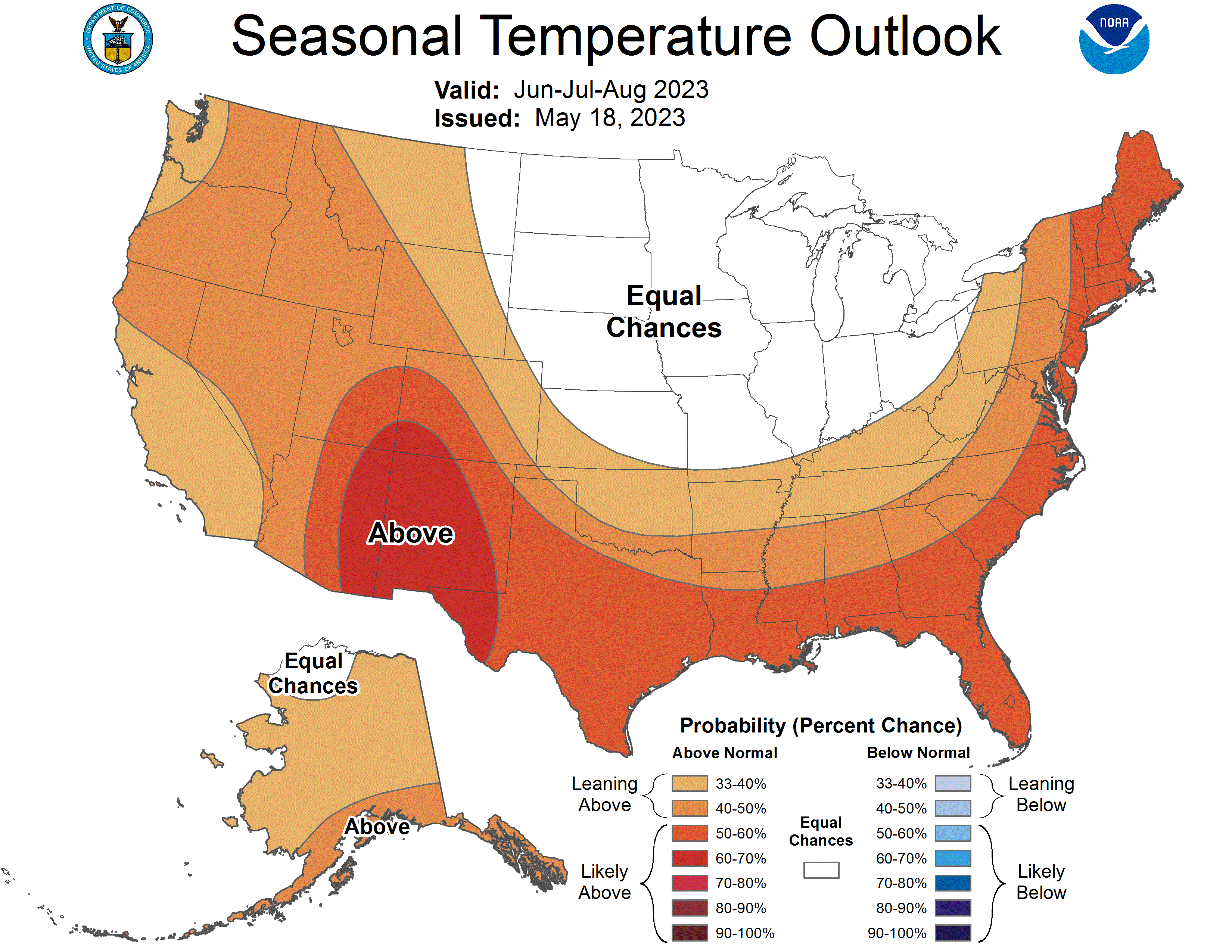 NOAA's seasonal temperature outlook for the summer of 2023.National Oceanic and Atmospheric Administration




 A sediment-strewn stretch of the Colorado River in Arizona, near Lake Powell.David McNew/Getty Images
