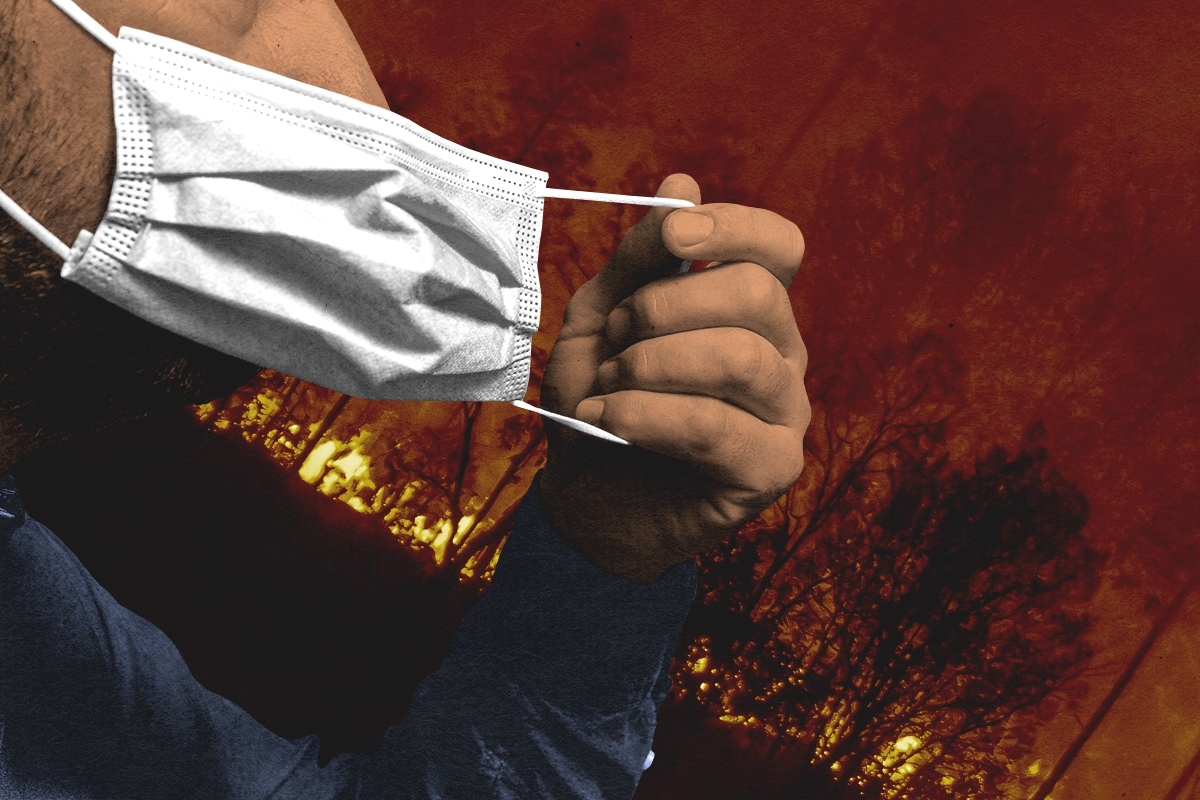
Six years ago this month, the Centers for Disease Control and Prevention began advising that even healthy individuals to wear face coverings to protect themselves against the spread of what we were then still calling the “novel coronavirus.” Mask debates, mandates, bans, and confrontations followed. To this day, in the right parts of the country, covering your face will still earn you dirty looks, or worse.
If there were ever another year to have an N95 on hand, though, it’s this one. This winter was the warmest on record in nine U.S. states; Oregon, Colorado, Utah, and Montana have also recorded some of their lowest snowpacks since record-keeping began. That cues up the landscape in the West for “above normal significant fire potential,” in the words of the National Interagency Fire Center, which issues predictive outlooks for the season ahead. And it’s not just the West: the 642,000-acre Morrill grass fire, which ignited in early March, was the largest in Nebraska’s history, while exceptional drought conditions stretching from East Texas through Florida have set the stage for “well above normal fire activity” heading into the spring lightning season. As of the end of March, wildfires have already burned more than 1.6 million acres in the U.S., or 231% of the previous 10-year average.
“Air pollution is the most significant toxic environmental exposure that the average person is ever subjected to, and wildfire smoke in particular is probably the most toxic type of air pollution [they’re] ever exposed to,” Brian Moench, the president at Utah Physicians for a Healthy Environment, a nonprofit clean-air advocacy group, told me.
Our understanding of just how dangerous that smoke is grows by the year. After having their grant pulled by the Trump administration, researchers at the University of California, Davis Health and UCLA persisted in publishing a report this winter reviewing more than 8.6 million births in California and demonstrating a link between exposure to wood smoke during pregnancy and the increased likelihood of autism. Another report, also published this winter by researchers from UCLA, estimated that the particulate matter from wildfire smoke is responsible for nearly 25,000 deaths per year in the United States, with no safe threshold for exposure.
“If a person is in a circumstance where they really can’t avoid wildfire smoke,” Moench added, “they absolutely should be doing everything they can to protect themselves.”
As public health offices around the country will tell you, one of the best ways to do just that is by donning an effective mask. N95 respirators specifically are about 95% effective at protecting the wearer against the dangerous particulates in wildfire smoke (although not gases or asbestos). Though not recommended by public health departments due to their comparative ineffectiveness, even surgical and cloth masks can offer limited particulate protection of about 68% and 33%, respectively.
But you have to actually wear them. After the Los Angeles fires in early 2025, health officials warned that exposure to toxic ash and dust remained a threat even after the air quality index returned to safe levels; one public health official who spoke to The New York Times recommended wearing a face mask for at least a month after the fires, a duration likely to feel interminable to all but the most cautious of people. “I think there’s a reluctance on the part of a lot of people to wear masks based not on anything other than they don’t want to make a political statement with their public outings,” Moench said. “I think there are a lot of people who just want to shy away from the controversy that they represent, irrespective of whether or not it’s a good idea.”
Moench has first-hand experience with the frustrating experience of promoting lung health in the polarized, post-COVID world of masking. Last year, Utah lawmakers floated a statewide mask ban with exceptions only for Halloween and masquerades — but not for legitimate health concerns such as poor air quality due to wildfire smoke. Though the ban was swiftly shot down, in part due to the outcry from disability advocates and environmental health groups, including Physicians for a Healthy Environment, the fact that the legislature floated it at all underscores how masks remain divisive, even years after mandates ended.
Many in public health have approached post-COVID messaging around masking by promoting scientific facts. Bev Stewart, the regional director of health initiatives at the American Lung Association of the Mountain Pacific, told me that in her experience, “It’s rare that somebody would say, ‘I would never, under any circumstance, wear a mask.’” She called the process of trying to reach skeptics a “conversation,” noting that there tends to be “a large misunderstanding about how lungs work” — namely, that masks offer protections that extend beyond the associations with the pandemic.
“Many types of air quality concerns could be mitigated with masks,” Stewart told me. “Sometimes we’re just thinking too narrowly about one specific instance and forgetting the forest for the trees.”
Others I spoke to, though, were doubtful that the populations who are most resistant to mask-wearing could be reached through facts alone. A portion of the country has “lost all respect for empirical evidence, facts, and science — virtually everything that modern civilization was based upon,” Moench said.
Jonas Kaplan, an associate professor of psychology at the University of Southern California, has put numbers to Moench’s conjecture. During the COVID pandemic, Kaplan studied how messaging can reach anti-maskers, discovering that when “information about masks was framed in terms of pure science, there was no significant reduction in anti-mask beliefs or change in mask-wearing behavior.”
Kaplan told me that a lot of the resistance in the anti-masking community comes down to, “What will people in public think of me? What would my friends think of me?” The most effective messages, he’s found, are those that speak to in-group values rather than presenting straight facts. “It wasn’t like, ‘Studies show that this is safe …’” broke through with the skeptics, Kaplan said. “It was more about emphasizing, ‘This is important, and we should care about it.’”
Science, though, does still have a vital role to play. Though we already have a better understanding of the impacts of smoke exposure than we did even a few years ago, more research is needed into its long-term effects. That will also give us greater clarity into how to best protect the more than 25 million Americans who are exposed to wildfire smoke every year — both physically, via better masks and air filters, as well as through better public health messaging.
“Smoke by itself — we know what’s in it, and we know you don’t want to breathe it in,” Emily Fischer, a leading expert on air pollution and a researcher and professor at Colorado State University, told me. “We also know that there are protective actions that families can prepare for, and do their best to take.”
Unfortunately, under the Trump administration, the Environmental Protection Agency, the National Oceanic and Atmospheric Administration, and the National Science Foundation, which had previously led research in the area, have drastically reduced their funding. Just this week, The Hill reported that NOAA has cut off grant funding to the University of Colorado’s Cooperative Institute for Research in Environmental Sciences, which, in addition to research into greenhouse gases, has extensively studied wildfire-related air pollution.
Fischer has been affected, too. “My team has had grants terminated related to air quality and protecting public health, and that’s really sad because the smoke doesn’t care if you’re a kid, if you’re elderly, or if you live in a red or blue state,” she said. “Families really need to think right now about how to protect themselves and their loved ones” against the smoke ahead, she told me.







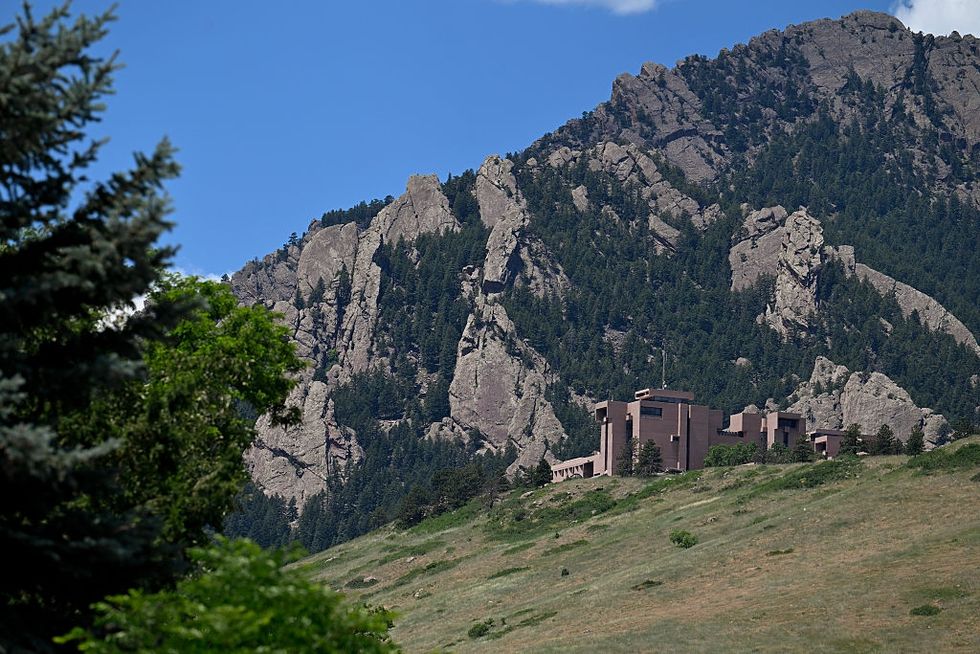 Founded in 1960, the facility has a uniquely beautiful architecture.Matthew Jonas/MediaNews Group/Boulder Daily Camera via Getty Images